
Jumping into AI without measuring readiness is a costly gamble. Here is how structured benchmarking and the right tools change the outcome.
Most organisations know they need to act on AI. The pressure comes from every direction: boards demanding competitive advantage, vendors promising transformation, and competitors already deploying. But enthusiasm without preparation is not a strategy. It is a risk.
The uncomfortable reality is that the majority of AI initiatives that stall or fail do so not because of the technology itself, but because the organisation was not ready for it. Data was fragmented. Processes were unclear. Teams were unprepared. There was no governance in place. And nobody had defined what success was supposed to look like.
Benchmarking an organisation’s AI readiness before committing to solutions is not a bureaucratic delay. It is the foundation on which every successful AI project is built.
“Without a clear readiness baseline, AI projects are built on assumptions. Benchmarking replaces guesswork with evidence.”
What AI Readiness Benchmarking Actually Means
AI readiness is not a single metric. It spans multiple dimensions of an organisation’s current state: the maturity of its data practices, the capability of its technology infrastructure, the preparedness of its people and culture, the clarity of its processes, and the strength of its governance frameworks.
Benchmarking means establishing an honest, structured baseline across all of these dimensions before any AI investment is made. It answers the critical questions that every organisation needs to confront:
- Is our data clean, accessible and structured enough for AI to work with?
- Do our people have the awareness and confidence to engage with AI tools?
- Is our leadership aligned on what we want AI to actually achieve?
- Are our processes documented clearly enough to be augmented or automated?
- Do we have the governance and security posture to deploy AI responsibly?
Without answers to these questions, use case selection becomes guesswork, implementation timelines become optimistic fiction, and return on investment becomes impossible to evidence.
The Four Phases of Structured Adoption
WaiFinder Adoption structures the entire AI journey across four sequential phases, each building on the last. This is not a framework imposed for the sake of process. It is a discipline that ensures organisations do not skip the steps that ultimately determine whether an AI initiative succeeds.
Phase 1: Assess — Establish a baseline across AI maturity, culture readiness and the current data landscape. This is the benchmark from which everything else is measured.
Phase 2: Improve — Strengthen the foundations. Data quality, governance structures, and user readiness are addressed before solutions are selected, not after deployment fails.
Phase 3: Identify — Use the BXT framework to prioritise AI use cases with impact scores measuring strategic alignment, business value, and executional fit.
Phase 4: Adopt — Execute pilots, scale what works, and embed AI-driven workflows into day-to-day operations with proper governance and change management in place.
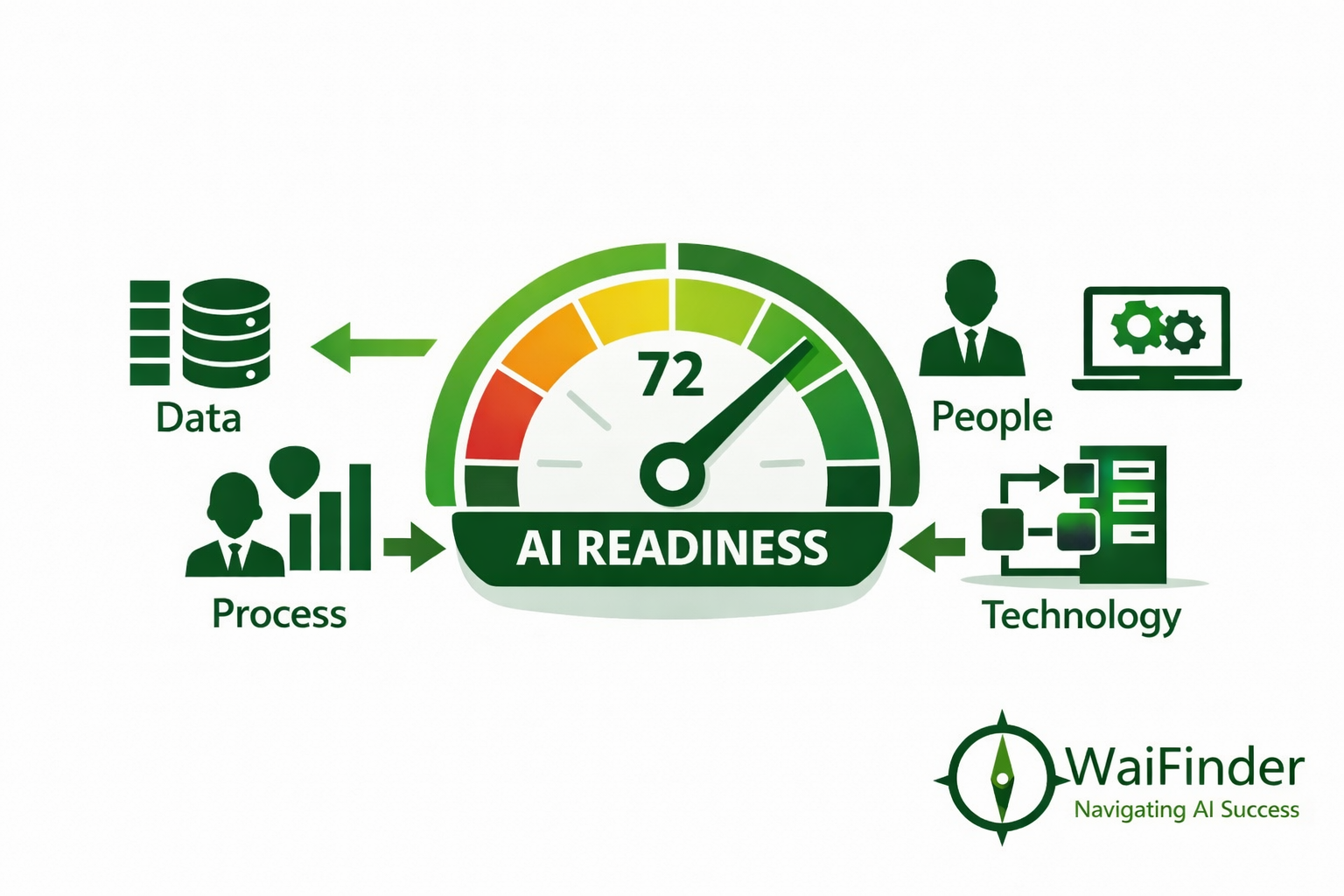
The Assess phase is where benchmarking lives. WaiFinder guides organisations through a structured series of questions covering their existing technology, data practices, AI ambitions, and cultural readiness. The result is a personalised AI Readiness Assessment that produces maturity metrics across four core pillars: data, process, people, and technology.
This is not a generic scoring exercise. The outputs are tailored to the organisation’s specific objectives, giving consultants and MSPs a genuine, evidenced starting point for every client engagement.
Prioritising with the BXT Framework
Once readiness is benchmarked and foundations are strengthened, the question becomes: where does AI create the most value for this specific organisation? Not every use case is worth pursuing, and not every AI initiative that sounds compelling will actually deliver. The challenge is making that selection with rigour rather than instinct.
WaiFinder uses Microsoft’s BXT (Business, Experience, Technology) framework to evaluate and prioritise AI use cases. Each potential initiative is scored across three dimensions:
Business — Does this use case align with the organisation’s strategic objectives? What is the commercial impact and return potential?
Experience — How will this change the experience of employees, customers or stakeholders? Is adoption realistic given the current culture?
Technology — Is the organisation’s data and infrastructure ready to support this? What is the implementation complexity?
The result is a curated catalogue of prioritised AI initiatives, each with impact scores, resource requirements, and complexity ratings. Rather than presenting a client with a theoretical list of AI possibilities, WaiFinder produces a ranked, evidence-based roadmap tailored to that organisation’s actual position.
This transforms the conversation a consultant or MSP has with a client from “here are some things AI could do” to “here is what AI should do for you, in this order, and here is why.”
Measuring Success: KPIs Built Into Every Implementation Plan
One of the most common failures in AI adoption is not technical. It is the absence of agreed success criteria before a project begins. Without defined metrics, it becomes impossible to demonstrate value, build internal confidence, or make informed decisions about scaling.
WaiFinder addresses this directly. Every implementation plan generated by the platform includes measurable KPIs as a core component, alongside detailed resources, task definitions, risk mitigation strategies, and governance guardrails.
The KPI dimensions WaiFinder recommends span the full adoption picture:
- Adoption Rate — active user engagement within defined timeframes
- Time Saved — reduction in task completion time against a pre-AI baseline
- ROI on Investment — revenue protected, costs avoided or efficiency gained
- Strategic Alignment — the degree to which AI outputs support business objectives
- Governance Compliance — audit trail adherence and policy enforcement rates
- Process Performance — quality and accuracy improvements in AI-augmented workflows
These are not generic benchmarks applied uniformly. Because WaiFinder’s outputs are aligned to each organisation’s stated objectives, the KPIs recommended reflect what success means in that specific context. A financial services firm improving compliance processing has different success metrics to a manufacturer automating quality checks.
Connecting readiness benchmarks at the start of the journey to measurable outcomes at the point of adoption creates a closed loop. Consultants and MSPs can demonstrate progress, identify where additional improvement is needed, and build a credible narrative of value delivery throughout the engagement.
How WaiFinder Enables MSPs and Consultants to Deliver
The commercial opportunity for MSPs and independent AI consultants is significant. Organisations across every sector need structured guidance for AI adoption, and most lack the internal capability or objectivity to navigate it alone. But delivering that guidance at scale, consistently, and profitably requires more than expertise. It requires the right tooling.
WaiFinder Adoption is built specifically to sit at the centre of a consultant’s or MSP’s delivery model. Rather than each engagement starting from scratch, WaiFinder provides the structure, the frameworks, and the report outputs that would otherwise require weeks of manual work to produce.
What MSPs and consultants can deliver with WaiFinder:
- AI Readiness Workshops backed by structured maturity diagnostics and evidenced scoring
- Improvement Roadmaps that give clients prioritised, actionable steps toward AI readiness
- BXT-driven Strategy Consulting aligned directly to each client’s business objectives
- Implementation Plans with defined KPIs, governance guardrails, and risk mitigation built in
- Ongoing value delivery as organisations progress through the adoption journey and use cases scale
The platform is built on Microsoft’s enterprise-grade infrastructure, giving both consultants and their clients confidence in the security, scalability, and compliance posture of the tool. It integrates with Azure services, Microsoft 365, and existing systems — a practical advantage for MSPs already working within the Microsoft ecosystem.
For consultants engaging smaller organisations, the structured outputs reduce the cost and time of evaluation significantly. For MSPs with multiple client accounts, the platform scales to support concurrent engagements without proportionally increasing delivery overhead.
Perhaps most importantly, WaiFinder shifts the nature of the relationship. Rather than an MSP or consultant being perceived as a vendor selling hours, WaiFinder’s structured, evidence-based approach positions the partner as a strategic advisor delivering measurable outcomes. That is a fundamentally different and more valuable commercial relationship.
“WaiFinder turns AI adoption from a complex, costly consulting exercise into a structured, repeatable, and evidenced delivery model.”
The Cost of Not Benchmarking
The temptation for many organisations is to move straight from AI interest to AI implementation. Vendors are willing to sell. Use cases are easy to imagine. The urgency feels real. But organisations that skip the benchmarking phase consistently encounter the same problems: solutions built on inadequate data, change programmes that outpace cultural readiness, and investments that deliver no measurable return.
For the MSPs and consultants engaged to deliver these projects, an unsuccessful AI implementation is not simply a client disappointment. It damages the credibility of the advisory relationship and makes future engagements harder to win.
WaiFinder’s readiness-first approach is not a constraint on momentum. It is the mechanism that turns AI ambition into AI outcomes. By establishing a clear benchmark at the outset, building improvement plans that genuinely address gaps, prioritising use cases with evidenced rigour, and embedding KPIs into every implementation plan from the start, WaiFinder creates the conditions for AI adoption that actually works.
For consultants and MSPs looking to build a credible, scalable AI advisory practice, that is the difference between a project and a practice.
WaiFinder Adoption gives MSPs and consultants the structure, tools and frameworks to deliver AI readiness benchmarking and adoption roadmaps with confidence. Request a demo to see WaiFinder in action yourself.